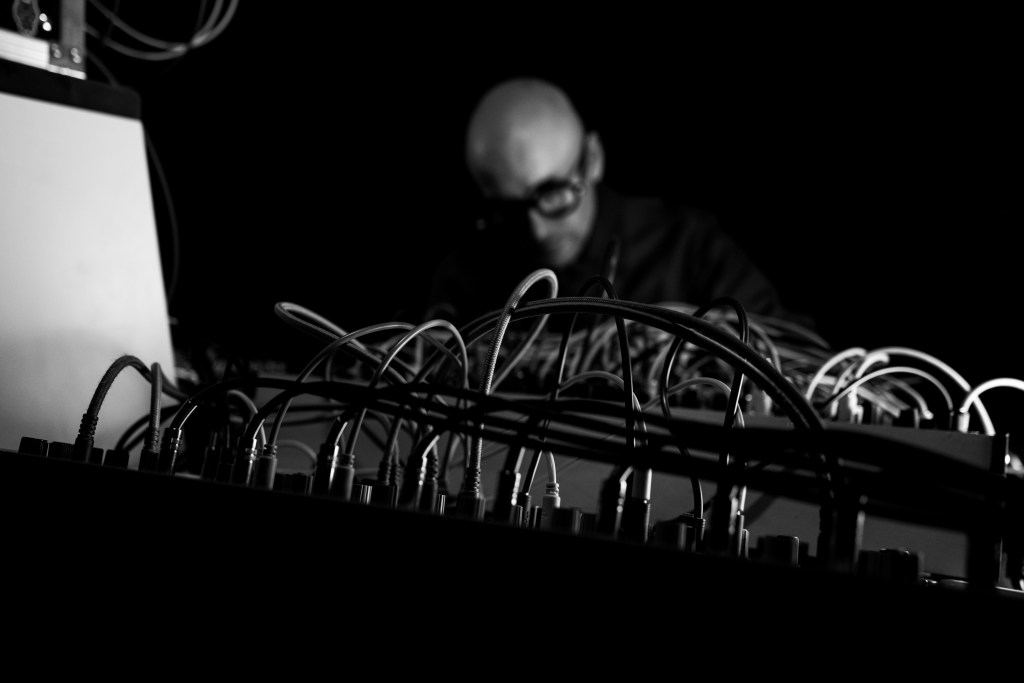
In a moment when electronic music seems to advance more through technical accumulation than expressive necessity, the return to risk becomes a position — if not overtly political, then at least existential. The debate is no longer simply analog versus digital, but something deeper: the domestication of error.
Modular systems were born as territories of indeterminacy. Free voltage, unstable processes, fertile accidents. Yet the gradual incorporation of optimization logics — USB connectivity, perfect synchronization, patch memory, quantized structures — has brought that space closer to the productive comfort of software environments. The underlying question is not technological but structural: what is lost when friction disappears?
In Rituals Of Being A Man, LIN/LOG responds to this tension on two levels: technical and symbolic. On one hand, he rejects sequencers and the possibility of saving configurations; on the other, he uses contemporary masculinity as a metaphor for structures oscillating between function, pressure and vulnerability. This is not a frontal ideological statement, but an exploration of states.
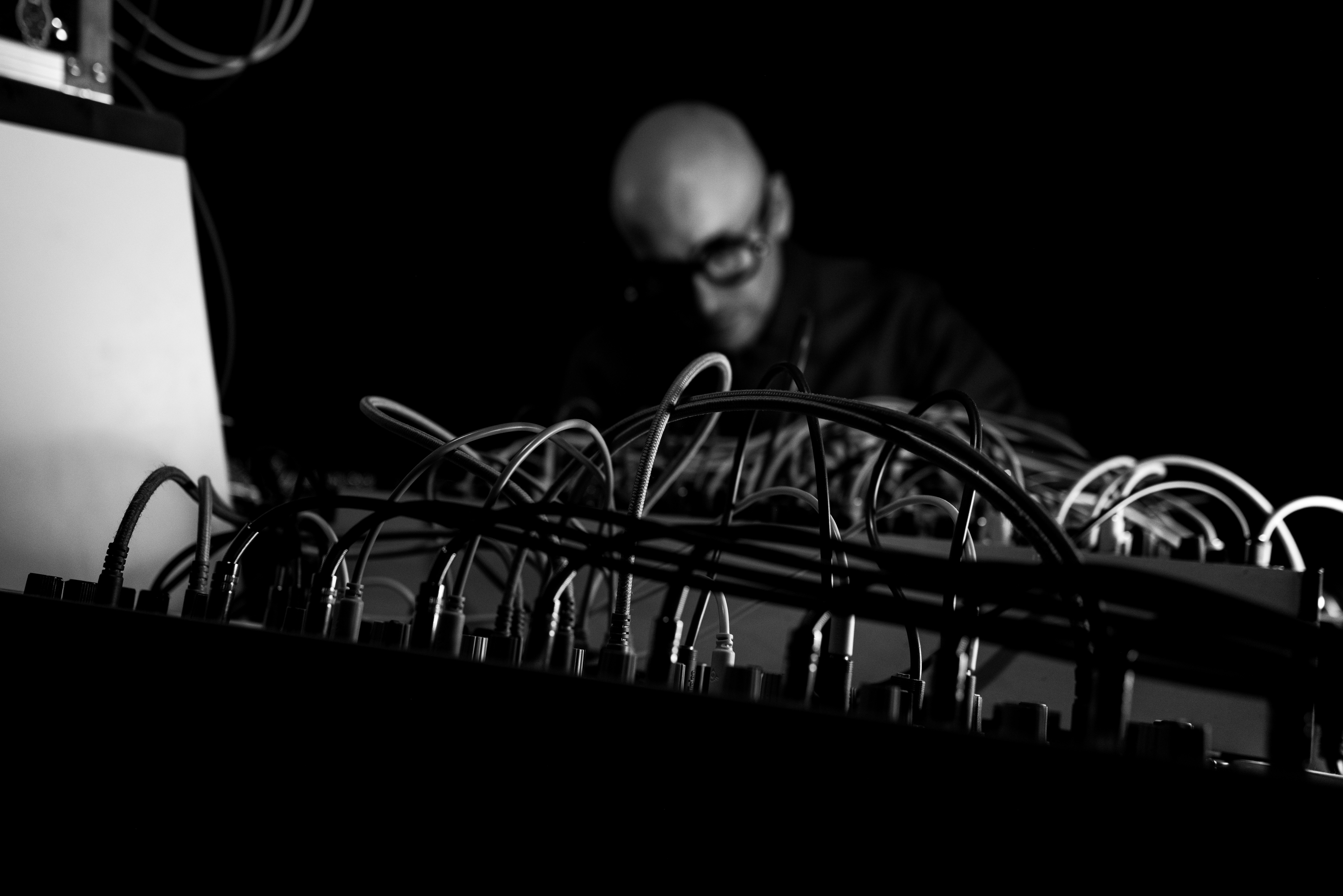
The album was recorded in single takes, always on the verge of collapse. Each piece emerges from the same fragile patch, self-sustaining until the artist intervenes minimally, altering parameters that trigger non-linear reactions. Stability is never guaranteed. The music breathes on that edge.
More than a conceptual album in the traditional narrative sense, Rituals Of Being A Man operates as a critical device: reflecting on the evolution of electronic music, on the standardization of sound, and on the functional expectations imposed both on machines and on bodies.
We talked with LIN/LOG about risk, imperfection, ritual and resistance.

I. The Loss of Archaic Voltage
Rituals Of Being A Man feels deeply conceptual. What was the initial idea that sparked this album?
I had the feeling that electronic music is losing its archaic roots. Modular systems gave us the opportunity to freely express ourselves without restrictions or guidelines. But nowadays you can observe music industry, influencers, traditional musicians intruding our safe space to impose their rules on us. As a result we now have modules that are like VST-plugins, communicating via USB or wireless, creating or receiving data, transforming free, unhinged voltage into “musical accurate” structures. With these findings I wanted to create something to respond on this development – something very personal, something more human.
You deliberately avoided modern modular conveniences like sequencers and saving patches. What did that limitation give you creatively?
Not being able to save and having no sequencer to program patterns on represents a state of savagery in todays music. Everything you carefully create can fuck up at any point. This also means you can record only once. This puts you in a situation where modern comforts do not exist. It’s like wilderness. And here our “unsophisticated man” is placed in a typical situation where he must prove his worth to survive. It’s like going back to one’s roots.
How did your relationship with modular systems change while working on this album?
I was able to improve several techniques and personal skills. It’s a never ending learning progress.
Do you see the modern man as a metaphor for the current state of electronic music? If so, how?
Yes. Electronic music today is easy to create. You don’t need much. Many of your tools (mostly software) will guide you softly through the process of creating a track. If you are working with samples you don’t need to fear inconsistency, because all the sound blocks are prepared by others and are ready to use, already sounding good without any further polish required. In the end you have an artificial, plastic version of what you could have done otherwise. The modern man is in the same initial situation. He has to not question his function. He has to not participate in trials of strength. To be a real man he has to earn money, an easy-to-understand value that is accepted everywhere – just like data music. Both, electronic music and the man are tolerated while playing their role. But luckily man has a secret weapon: humor.
You’ve expressed concern about electronic music evolving more technically than artistically. What do you feel is being lost in that process?
I mourn that there are less very talented artists in the field of electronic music willing to fight for their sound, which means that they have to make difficult decisions in life in order to make their music be heard by an audience. Question yourself: would you pay high amounts of money (which will not be available for going on expensive vacations or other stuff) for gear, writing thousands of notes, spending almost every minute of your life on improving sound for only a small chance of being heard? On top of it: could you live with what people say about your music if they don’t accept it? It’s a hard choice. If you want to make your very own sound, you need to become a tough dog.
II. Masculinity as Fragile Structure
The title points directly to masculinity. How do you personally define “being a man” in the context of this record?
Society often speaks of men in a context of depreciation, where attributes like aggressiveness are highlighted. And when it comes to these discussions, all men are treated as one and the same person. That is pretty ironic since society always stresses individuality, but when it comes to the topic of masculinity all men are said to act the same. Also, when talking about feelings, I rarely hear anyone asking how a man feels about various topics. I wanted to point out typical situations of modern daily life and how men feel. No political discussions, no sexual differences, just how it feels to wake up as a man and – like a piece on this album mentions it – getting his job done, which not only means working in a job but also monitoring the world, trying to keep it working.
The album constantly balances strength and fragility. How did you translate that tension into sound?
Correct. I have created a patch that all pieces on the album are made with. It was all about a fragile state that was simply looping by interwoven events of switches and end of cycle gates when nothing was touched, for example. I was the one disrupting the patterns by changing simple attributes like envelope shapes. This forced the network to react in a non-linear way and altered processes like LPGs being pinged at slightly different timings or switches now outputting other states of the same material being processed. I wanted to have something that doesn’t sound too random so I chose the Delptronics lDB-2 drum modules to be the most recognizable part of the patch, because rhythms are easier to follow and underline the meaning of archaic music. Most of the other modules are Grant Richter designs and therefore I also used his fascinating mixing technique, introducing the idea of cadavre exquis to the modular world, which makes even the mix unstable and highly interesting.
Many of the track titles refer to everyday actions. How do these mundane rituals connect to the album’s emotional core?
Every day is made up of rituals. You probably don’t recognize them as such: checking yourself in the mirror, shaking hands, stopping on a red traffic light, watching each episode of a series, laughing when your boss laughs. I see musical patterns and patches as rituals, too. It’s an offering – to yourself and to others. It’s a purification of your soul.

III. Risk, Collapse and Continuity
The tracks were recorded in single takes, always close to collapse. What role does risk play in your artistic process?
Risk is a significant aspect of all my works. Whether performing in absurd places like a police cell or working with sequencer-less setups, I like positive stress situations. It forces the mind to break out from standardized solutions. Also, I like to keep little failures and quirks that machines or I cause in the recordings. You see, beauty means that something stands out despite all imperfection – which makes imperfection indispensable!
How does Rituals Of Being A Man reflect the broader philosophy of LIN/LOG as a project and label?
I started the LIN/LOG project to have a space for my own ideas. Rituals of Being a Man comes from notes I wrote down years ago. I like to brood over something for some time. Fighting with myself over how an idea can be realized takes most of the effort. Once the fight is over, the actual work is done pretty fast, eruptive, highly focussed. This album is very typical for me.
What kind of listener do you imagine connecting most deeply with this album?
At this point I must mention that this album is not made for only men, of course. That would be weird. It is art and wants to encourage everyone to think outside the box. Life is difficult and has many truths. I love to find new and inspiring music, maybe there are people thinking similarly of this work.
In a world oversaturated with new sounds and releases, what do you hope makes this record endure?
I put my own car on the cover. Isn’t that cool? 😊
After completing this album, did it change how you see your role as an electronic music artist today?
Completing this work was a relief. I can now go on through all the other disastrous ideas in my mind.
–
In a landscape optimized for recall, Rituals Of Being A Man insists on irreversibility. No presets. No undo. No guarantees.
Perhaps what LIN/LOG proposes is not a return to purity — an impossible gesture — but a return to exposure: to the unstable voltage where identity, machine and sound are still negotiating their form.
And in that negotiation, fragility is not weakness. It is structure under tension.
Label: LIN/LOG
Artist: LIN/LOG
Title: Rituals Of Being A Man
Format: Album
Catalogue: LL049
Release Format: Digital
Genre: Modular Techno, Experimental
Distribution: Believe Digital
Domain Label: lin-log.de
Release Date: February 20th, 2026
Support & Buy: lin-log.de
Tracklist
01: Morning Shave
02: Looking Menacing
03: Unhooking the Damn Bra
04: Driving Around the Block in Sorrow
05: Watching Her Talk
06: Fixing It Quickly
07: Midlife Crisis
08: Getting the Job Done
LIN/LOG
Club Furies
Website | SoundCloud | Instagram | Threads | TikTok | Facebook | Bandcamp | Linktree
 Club Furies
Deja un comentario