Editorial introduction
For Catastrofe Club, the extinction of the human species is not a threat. It is the resolution.
Josep M. Herrera and David Molina have been building their singular universe from Roca Umbert Fàbrica de les Arts in Granollers for over a decade — an unclassifiable project that moves freely between post-punk, darkwave, electronic and post-rock without the slightest trace of self-consciousness. Their first three albums were, in their own words, the soundtrack of a world without direction, of a society heading straight for the edge. Un Futuro Tranquilo arrives after that trilogy closes, and proposes something stranger: the day after. A future in which humanity has already disappeared, and the rest of living beings can finally breathe.
This is their fourth LP and their first on Periphylla Records. The darkness is still there — but it sounds, and feels, brighter than ever. The messages remain raw, the humour remains peculiar, the vocals remain mostly spoken-word over richly layered electronics. What has changed is the calmness. Catastrofe Club have accepted the catastrophe, and it suits them well. We spoke with them about the end of everything — and why it might be good news.
The interview was conducted and answered in Spanish, and the English translation was produced using DeepL and reviewed by Club Furies
I. The trilogy and the reset
01 Your first three albums formed a trilogy of their own. What did it feel like to close that chapter — and what made you decide that the fourth record had to begin somewhere completely different, on the other side of the catastrophe?
— A: In all cases of bereavement, the first stage is denial, followed by a stage of grief and anguish, and finally the stage of acceptance. It is this last stage that brings healing. Surely the suffering of watching everything around us crumble over the years has ultimately led us, naturally and without premeditation, to this final stage, the one that sets us free. We accept defeat with calm. This leads us to write serenely about human extinction and to emphasise the beauty of a world in which the other species live, at last, in a certain harmony.
02 The press kit describes Un Futuro Tranquilo as «a kind of reset.» What does a reset sound like for Catastrofe Club — what stays, and what had to change?
— A: This fresh start leaves behind the anguish and suffering. The new album transports us to a new world full of relief, where there is nothing but peace. This has given us a breath of fresh air on a personal level throughout the creative process and has also breathed new life into the music itself, which – without losing our essence – has evolved into something more expansive, more ethereal and lighter.
II. The concept — extinction as relief
03 The album sets out an uncomfortably peaceful future in which the human species has already disappeared — and frames that as good news for every other living being on the planet. How seriously do you mean it?
— A: We mean this entirely seriously. There’s no irony in it.
04 You describe yourselves not as visionaries but as chroniclers — of a reality many are still unwilling to face. What does it mean to chronicle something like this through music rather than through journalism, activism, or silence?
— A: We have other small ways of getting involved in activism. But Catástrofe Club is a project that encompasses music, lyrics and visuals too. And it is this project that allows us to portray and capture with greater clarity the decline that we witness every day.
05 The tracklist moves from «En el futuro» to «El fin de la especie» to «La belleza» to «Nadie.» That arc feels deliberate — almost liturgical. Did the sequence emerge from the concept, or did the concept emerge from the sequence?
— A: The concept emerged from a single song, ‘En el futuro’, which is the opening track on the album. The song depicts a world where humans have already become extinct and where animals and plants are finally able to live in peace and harmony. Once we’d finished the song, we realised straight away that this idea could be developed, expanded upon, and could form the basis of an entire album.
III. The sound
06 On this record you lean further into post-rock and cinematic territory while keeping the post-punk and darkwave energy. What pushed you in that direction — and how does the expanded sonic palette serve the expanded emotional register of the album?
— A: To be honest, there was no intention behind it. The very theme of the album transported us mentally to that world full of peace and harmony. And that led us, song after song, to a more ethereal, more expansive sound than on previous albums. It all happened very naturally and spontaneously. In any case, regardless of styles and nuances, everything we do still sounds like Catástrofe Club.
07 The press kit mentions that your darkness «sounds and feels brighter than ever» on this LP. How do you make darkness sound bright without losing what makes it dark?
— A: We are beings of light; we are drawn more to the light than to the darkness. However, a certain amount of darkness is always lurking, both within us and before our very eyes. Our music reflects exactly that: light and darkness never touch, but they walk hand in hand. Both are authentic, real, walking side by side. Just as in life.
08 Your vocals are mostly spoken-word — raw, direct, laced with humour. On an album about the end of the species, what does humour do that solemnity can’t?
— A: Rather than humour, what we’re really trying to do is show the viewer some affection. To tell them, in a gentle way, that they’re about to disappear and will never be here again. It’s like giving them a warm hug before breaking news that they’re bound to find unsettling. We probably use a certain amount of humour as an emotional entry point, as a necessary anaesthetic before the lethal injection.
IV. Influences and identity
09 The press kit places you between The Cure and Sigur Rós, Idles and Fontaines DC, Astrud and Punsetes, Albert Pla and Faemino y Cansado. That is a genuinely unusual range. How do you hold all of that together without it collapsing into pastiche?
— A: They are simply some of the influences we’ve grown up with. We’d love to have traits of all those monsters. But it’s true that they’ve all left their mark on our personal development, on how we’ve matured since our teenage years. And in some way, that’s inside us, lying dormant, probably shaping some tiny part of our creative process.
V. Periphylla Records and the release
10 Un Futuro Tranquilo is your first release on Periphylla Records. What does that change — if anything — about how the album reaches the world, and what it means to release something this particular through a label?
— A: Our relationship with Periphylla is undoubtedly the story of a happy, chance encounter. We saw in them – and in their parent organisation, Diffuse Reality – a collective very much in tune with our own way of understanding life and creativity. We discovered a team of people who prioritise artistic intent, a love for the community and a passion for creative projects, going beyond traditional norms and clichés. They placed their trust in us by featuring our live performances at several of their events, and we are proud that they are the ones helping us to distribute our work across various countries. Having travelling companions like them is a gift. Whatever time we have left in this world, it is worth sharing it in this way.
VI. What comes after
11 The album ends with «Nadie.» After you’ve narrated the end of the species — calmly, without trauma — what comes next for Catastrofe Club?
— A: Probably nothing. We won’t be around anymore. We won’t be able to write songs, and there won’t be anyone left to listen to them.
Editorial closing
Un Futuro Tranquilo is an ood about the end of everything that somehow manages not to be depressing. Catastrofe Club have spent a decade chronicling collapse with black humour, raw language and a singular ood universe that belongs to no genre and sounds like no one else. Their fourth LP closes a trilogy and opens something stranger: a world after us, quieter, more beautiful, without trauma. If this is what the apocalypse sounds like, at oodtit has ood music. Out October 7th on Periphylla Records.
Artist: Catástrofe Club
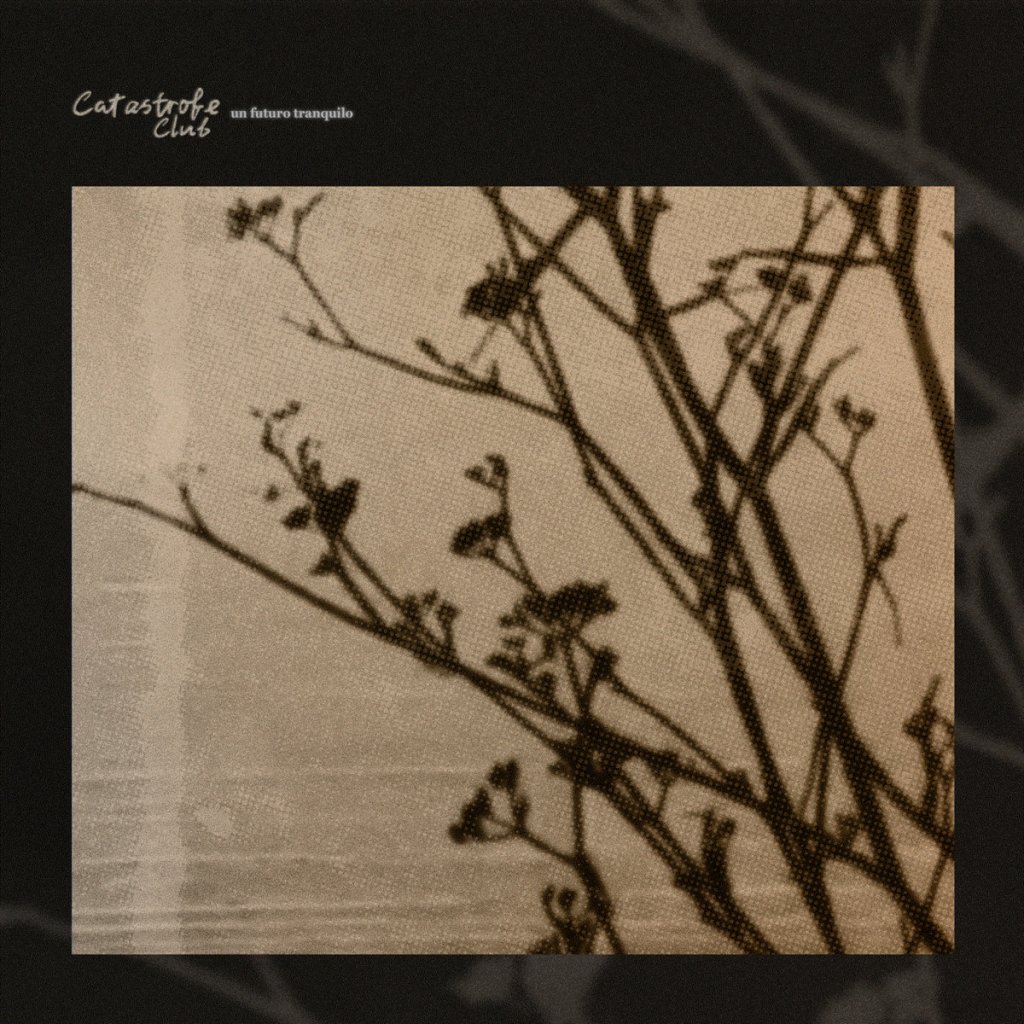
Title: Un futuro tranquilo
Format: Vinyl, 12»/ Digital
Label: Diffuse Reality / Periphylla Series
Catalogue: PY 222
Release Date: July 10, 2026
Support & Buy: Bandcamp
Tracklist
A1. En el futuro
A2. Todo sigue
A3. Casa piedra camino
A4. Satélites
A5. Querido yo
B1. El fin de la especie
B2. Un día mejor
B3. La belleza
B4. En el futuro II
B5. Nadie
Credits
Written and Produced by Catástrofe Club
All vinyl orders include two Diffuse Reality stickers and digital downloads of the full release.
Josep Maria Herrera (vocals, guitars, programming).
David Molina (bass, programming)
All tracks written and produced by CATASTROFE CLUB.
Recorded at the “Fábrica de Galletas” (CATASTROFE CLUB home studio) in 2025, except for the vocals, which were recorded by Dani Gil at Siete Barbas Estudio (Barcelona) in January 2026.
Mixed and mastered by Dani Gil at Siete Barbas Estudio (BCN) between February and May 2026.
Design and artwork: Raquel Castro and Joan Antoni Martori.
Catástrofe Club
Instagram | Facebook | Bandcamp | Linktree
Periphylla
SoundCloud | Instagram | Facebook | Diffuse Reality Records
Club Furies
Website | SoundCloud | Instagram | Threads | TikTok | Facebook | Bandcamp | Linktree


Deja un comentario