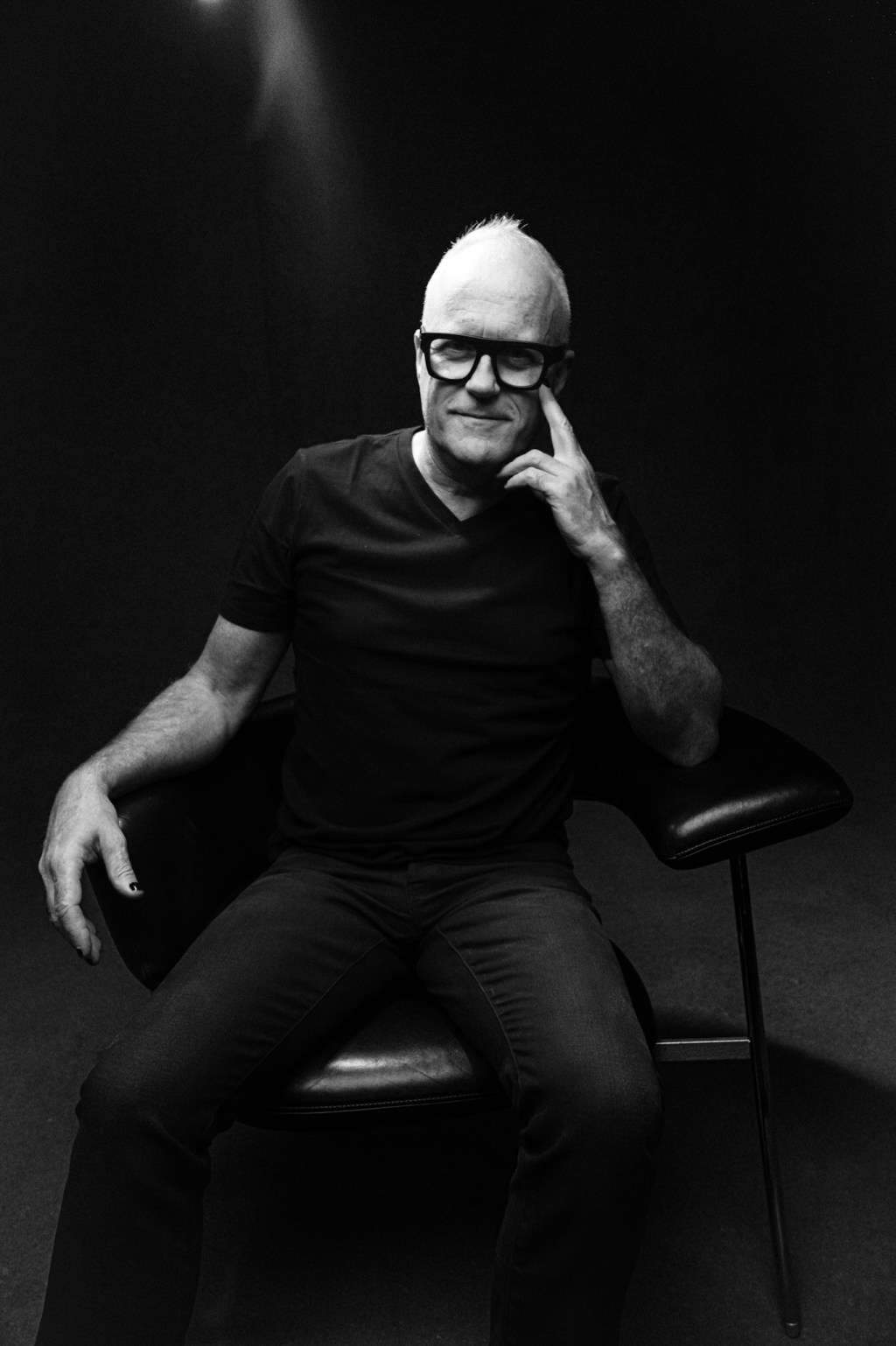
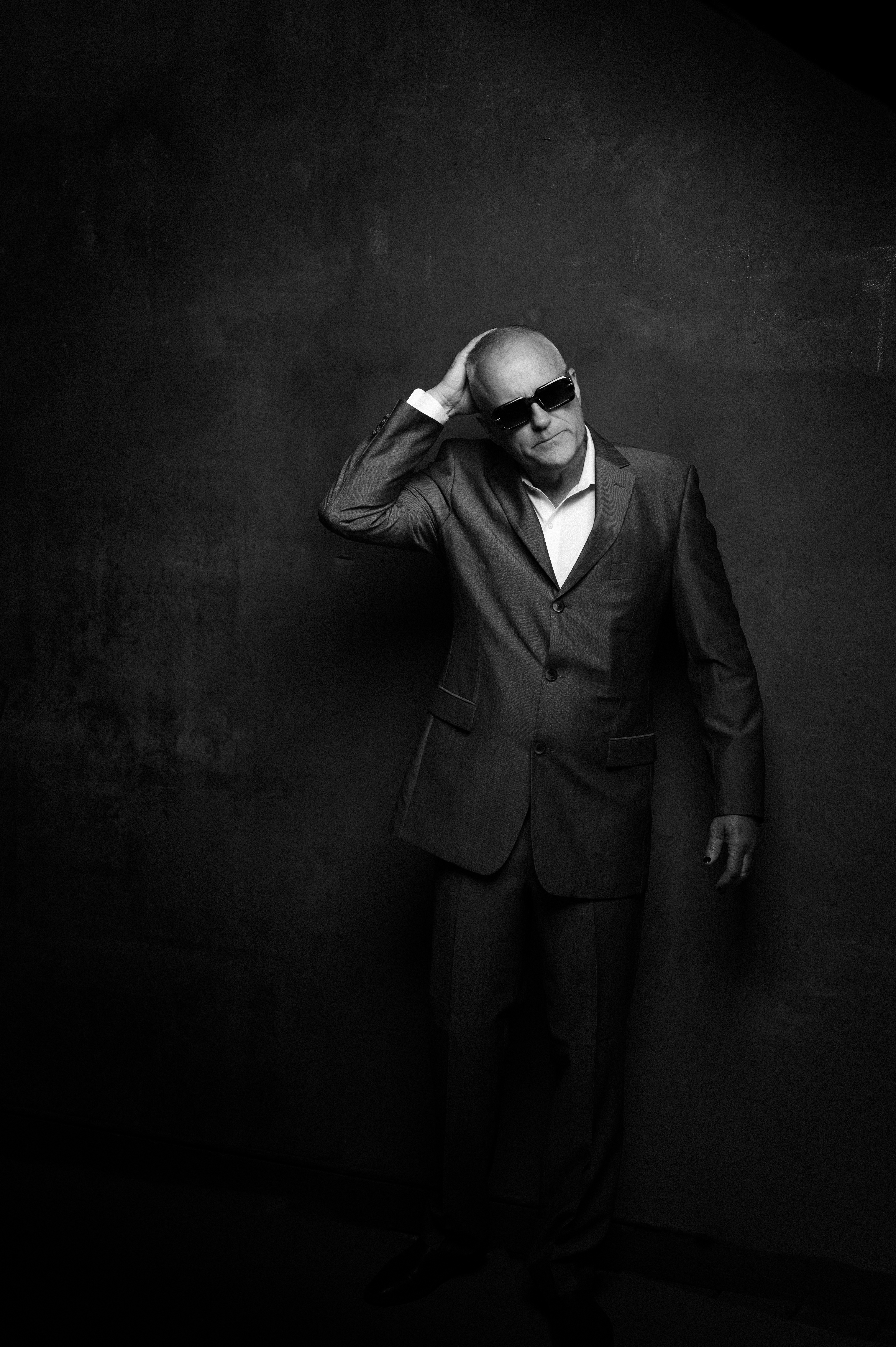
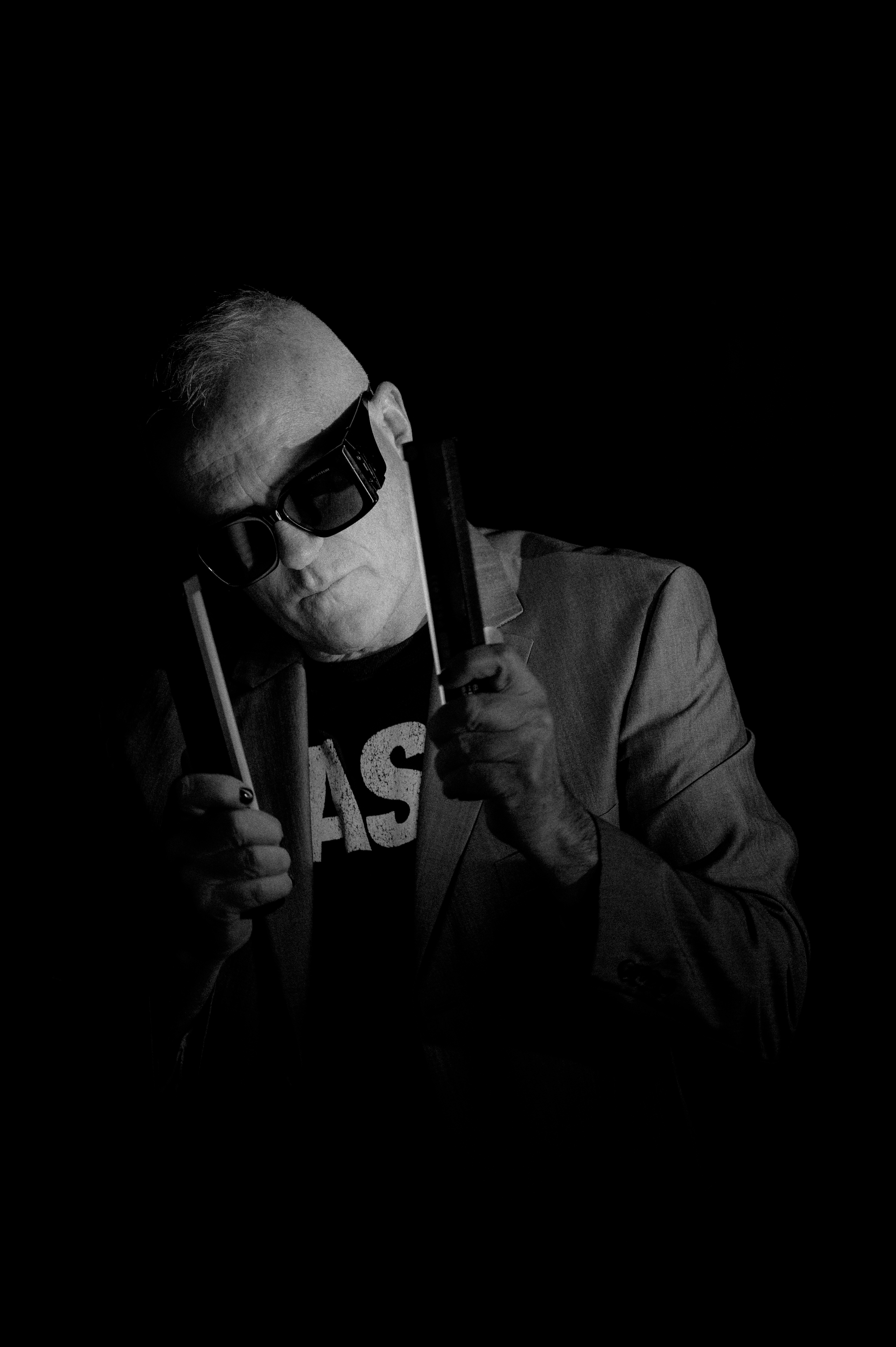
Some albums arrive with a concept so precisely articulated that the music barely needs defending. Gunfactor, apaull’s new record on Furnace Room Recordings, is one of them. Ten tracks navigating the pathways to fame — and infamy — across a sonic palette that moves from techno to synthwave by way of industrial, always with an economy of means that signals someone who knows exactly what they’re doing. The title lettering is by Al Diaz, a past collaborator of Jean-Michel Basquiat. The photographs are by Dave Clarke. We spoke with apaull about the album, its contradictions, and the questions it leaves unanswered.
Club Furies: The title operates simultaneously in two languages with meanings that don’t contradict each other but pull in different directions. Was that tension intentional from the start, or did the linguistic ambiguity emerge during the process and you decided to let it do its work?
apaull: The tension was intentional. The Dutch meaning came first, though. I was having coffee with a Dutch booking agent and she said you need produce good music but also have the “gunfactor”, this intangible ’it factor’ to become successful (and famous). The immediate question is how does one achieve that “it factor”. The theme developed from there. Either you have exceptional talent which leads to fame or you are somehow notorious, which leads to infamy.
Club Furies: The album draws an implicit distinction between earned fame and inflicted fame. Tracks like «Veilig» or «King Dome» seem to inhabit that grey zone where recognition arrives through circumstances no one would have chosen. How do you construct that difference narratively without collapsing into moral judgment?
apaull: Great question. While I have strong personal views I try to present things agnostically. I create perspectives in my tracks, that sometimes belie my personal views, but are really there to ask the listener what they think. It’s like listening to a painting. What do you hear and what do you think about it?
Club Furies: «Finishing School» summons something from another era that, by your own notes, «might still hold true today.» What strikes you as more unsettling: that those ideas persist, or that we still have to keep saying so?
apaull: “Finishing School” is a tongue in cheek examination of societal structure. In previous eras, roles were more clearly defined than they are today, if not over the top rigid. Today we find ourselves in jello, where structure has been systematically removed. We now live in an open concept society, if not over the top lax. “Finishing School’s” light hearted question is do we need some of that structure back.
Club Furies: The album has very specific geographies: Berlin in January, Detroit, New York implicit in «Veilig.» Do those physical contexts affect the compositional process technically — in the sound, the tempo, the processing — or do they function more as states of mind?
apaull: Both. I absorb where I am and this influences my state of mind and how I write. I write music almost continually and love writing in hotel rooms. For instance, the album track “Fang Mich” (Catch Me) was written and produced in Berlin. It captures the vibes I soaked in from the winter weather, Tresor & Berghain techno forays, a cold and jet lag. I live two hours from Detroit, the birthplace of techno, and go there for Movement each year. Detroit techno is pretty straight ahead but with indelible flashes of house. It is warmer than Berlin techno. The track “Veilig” (Safe) was written about something that happened in New York. I have been there many times and carry the vibe of this ‘infinite city’ with me.
Club Furies: «Cartel» proposes a kind of inverse moral relativism. It’s arguably the album’s most conceptually exposed position. What was the writing process like for that track: did you start from the concept or arrive at it through the music?
apaull: I came accross the vocal sample first and used it as the track’s foundation. I wrote the music around this sample (normally I do it the other way around). I found it interesting that a politician would compare a global body (World Economic Forum) to Columbian drug cartels, the point being that the espoused global organizations are cartels, in there own right. The pandemic made clear that this is the case.
Club Furies: «True Though» suggests that sufficient fame functions as a shield. What’s interesting is that the track doesn’t sound like furious critique — it sounds more like resignation. Is that emotional ambiguity deliberate, or is it what came out?
apaull: My song writing is about providing a perspective, without the proselytizing that fury might evoke. I create these track perspectives to be there subliminally, that is you will only hear them if you listen deeply and far away from the club. “True Though” is about how Canada’s now former prime minister could not remember how many times he had donned ‘black face’, was somehow not cancelled and was still able to ascend this high office. While I’m a firm believer in redemption, I doubt that other politicians would have received this benefit of the doubt.
Club Furies: You close the album with «Altamont Joy,» which ends on «You’re gonna look real crazy, being on the other side of that line.» That line can be read as a warning, a statement of fact, or an irony. Did you want it to be all three at once?
apaull: The sample, in question, was delivered, by the speaker, as an omimous warning. It presents two perspectives, the speaker’s and the other, across some imaginary dotted line into a philosophical ‘no mans land’. The point of the track is that we cannot function with this level of polarization because the ability to discuss and reach consensus is lost.
Club Furies: Bringing in Al Diaz for the title lettering places the record in a visual conversation with eighties street art and everything that history implies. How did you come to him, and what did you want that choice to communicate?
apaull: I met him through my friend and artist, Jason Maclean, on one of my trips to New York, and was mesmerized by his history and works. I was quite taken by his lettering (assembled from New York Metropolitan Transit Authority posters). For the purposes of creating visual artistic continuity between my releases I thought this lettering would work well.

Club Furies: Every track on the album has a remix. That’s a structural decision, not an accessory one. What interests you about the dialogue between your version and another artist’s reinterpretation? Are there tracks where that tension feels particularly generative?
apaull: I made a decision, early on, to release on my own label because I was new, wanted full control of my music and didn’t think the slog of attracting label interest was a good use of my time. Working with remixers was a good alternative to labels. I work with remixers for two reasons: 1. To have them create more danceable and club friendly versions of a track; and 2. To introduce my music to their audiences. The bonus is that I have been able to work with artists who I respect and admire, and learn from them.
Club Furies: Your music operates in a space where peak time and after-hours aren’t opposites but continuities. That implies a certain resistance to the kind of specialization the market tends to reward. How do you think about that position in relation to how electronic music circulates today?
apaull: I see my music as art. While notionally it fits into the techno genre, I spend no time trying to get it to fit what is being played in clubs. While I enjoy club music, I see what is produced as being derivitive more than specialization. Clubgoers enjoy this musical continuity and for producers it can be a pathway to success. There is nothing wrong with that. I work diligently to create a sound, that is grounded but unique, and then work even harder to find the right audience. My work with club friendly remixers, as described above, is an invitation to their audience to become part of mine. Over time, what I produce will continue to work its way into clubs and other venues.
Club Furies: Furnace Room Recordings is now thirty-six releases in. What does running your own label mean for a project like yours? Does the autonomy change what you’re willing to sign off on?
apaull: The label means I get to release what I want and build a solid catalog that I control. It is a platform that now allows me to present my music to potential labels, remixers and venues and work to attract their interest. My goal is to write and professionally produce interesting tracks. I only sign off on and release tracks after my team has given their stamp of approval.
Club Furies: If the album asks «do you have the gunfactor?» — what’s your answer?
apaull: Ultimately, that is for others to decide, but, to save them some time I would say, YES.
Gunfactor is not a comfortable record, and it doesn’t try to be. It is a work that observes, with clinical detachment, the mechanisms by which the world rewards, ignores, or destroys people — and has the honesty not to offer solutions. In a circuit that often consumes itself in its own effervescence, apaull builds something slower and more durable: a body of work with edges, with conceptual texture, with the kind of coherence that can only come from someone who has been at this long enough not to need to impress anyone.
The question that titles the album stays open. Perhaps that is the only honest answer there is.
Gunfactor is released April 24, 2026 on Furnace Room Recordings (frr036), distributed by Superstition and available on all platforms. Remixes accompany the album as single and EP releases.
As a complement to the Gunfactor release, the inclusion of the Dina Summer Remix, set to be released on May 22, adds a significant layer of contemporary energy to the project. This remix not only reinterprets apaull’s sonic vision but also serves as a strategic bridge for listeners to further explore the creative process detailed in this interview.
artist: apaull
Album: Gunfactor
Release Format: Digital
Cat. No. frr036
Distribution: Superstition, all online platforms
Release Date: April 24, 2026
Pre Order FurnaceRoomRecords.lnk.to/Gunfactor
apaull- writing, producing, mixing
Abe Duque- Executive Producer, mastering
Tracklist
1. Fang Mich 04:07
2. King Dome 05:20
3. Push the Button 06:10
4. Veilig 04:38
5. Finishing School 05:05
6. Gunfactor 05:34
7. Cartel 07:11
8. True Though 05:04
9. Payload 05:32
10. Altamont Joy 07:30
apaull
Website | SoundCloud | Instagram | Facebook | Bandcamp | Linktree
Furnace Room Records
Instagram | Facebook | Beatport
Club Furies
Website | SoundCloud | Instagram | Threads | TikTok | Facebook | Bandcamp | Linktree


Deja una respuesta