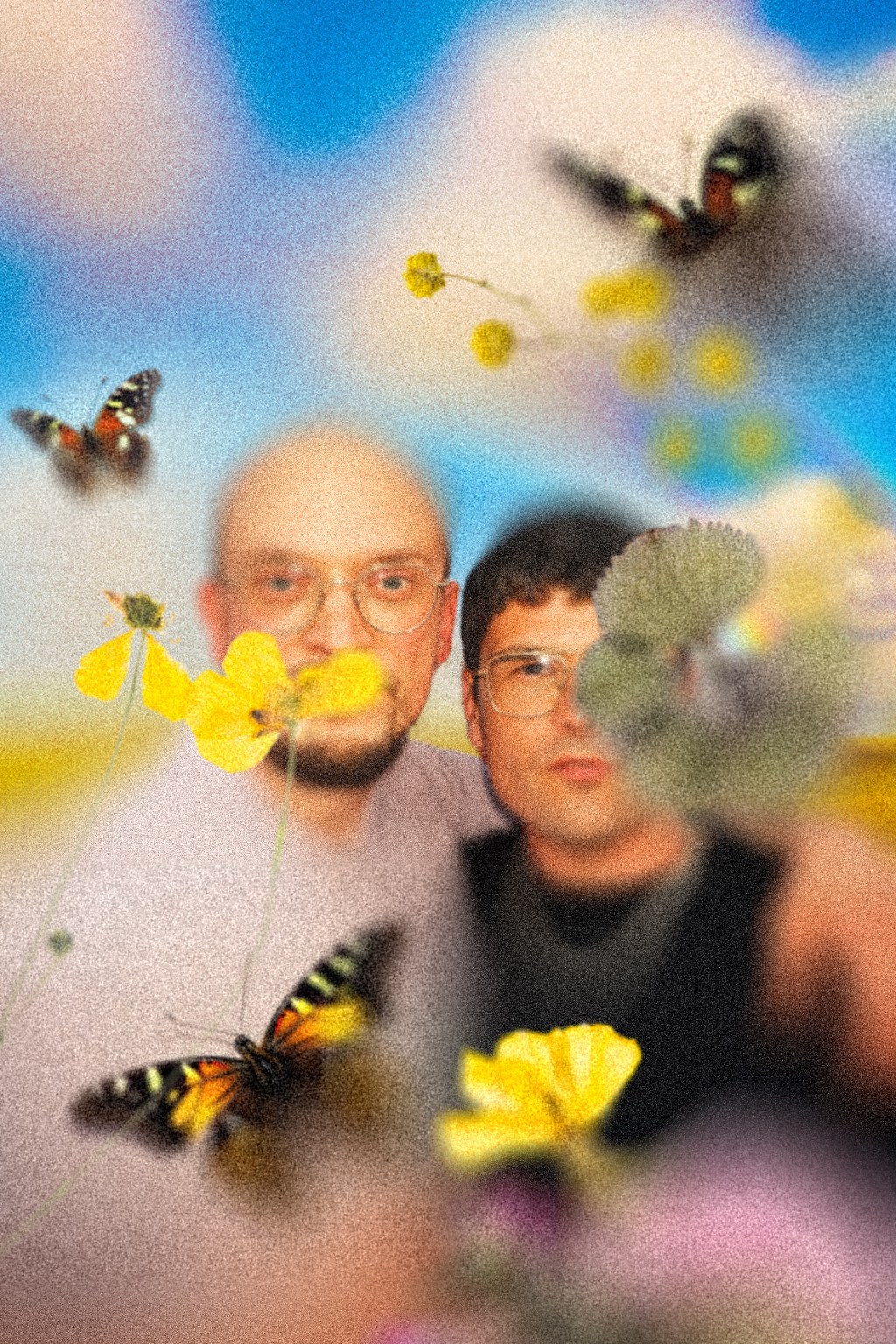
Some collaborations feel like a meeting of opposite worlds. Others feel more like two people who were always in the same room. qrauer, the German project that moves between orchestral soundscapes, minimal techno and IDM, and TAPE SHIFTER, the solo project of Dresden-based drummer and producer Demian Kappenstein, are closer to the second kind. Together they have just released Times New Romance, a five-track EP on Sonderling Records (Beso05), out since November 6, 2026, with guest appearances by Paul Frick (Brandt Brauer Frick, Tangerine Dream) and Moritz Fasbender, the electronic alias of composer Friederike Bernhardt.
The Berlin label founded by Dapayk is a natural home for a record like this. We wanted to know how it came together, so we sent the duo a few questions, some for both of them and a couple for each.
1. Your worlds are quite different on paper: one project rooted in orchestral textures and minimal techno, the other in jazz drumming, old tapes and drum machines. How did you two first cross paths, and when did you realize there was a record to be made together?
For more than twenty years we have both been living and working parallel in the city of Dresden and came across each other more in live-music contexts of hand made music since we both work as drummers. Christian for Woods of Birnam and Demian for ÄTNA and Masaa. Once we realized our equal interest in the production of electronic music we started hanging out and jamming, organized live gigs with improvised dance music only. Then we really wanted to share our vision for knarzy four on the floor with the world and worked on our first EP Herzblatt.
2. (For Demian / TAPE SHIFTER) Your solo work fuses old tapes of jazz, meditation and folklore with the raw pulse of drum machines. Where do those tapes come from, and what makes a tape worth bringing into a track?
I love collaging tiny snippets of seemingly very contradicting origins. This can be solo jazz demo tapes from the nineties from musicians trying to get club gigs, meditation classes, politician’s autobiographies and other weird sounds such as bird categorization tapes. The listener’s mind can create something completely new from it and freely associate really quick. A lot of surprises come past raising the question was that just a…?
3. (For qrauer) Your music runs from orchestral drones with glitch effects to delicate lo-fi pianos and minimal rhythms, and it rarely gives up danceability. What does a collaboration ask you to leave behind, and what do you hold on to?
Working with Demian means I don’t have to focus on so many things at once. Usually, when we work together, I use a drum machine and perhaps a simple sampler, and I can concentrate entirely on improvising together, allowing me to dive deeper into this world.
4. Sonderling Records is known for a wide curatorial range, with sub-labels covering everything from melodic techno to experimental electronica and ambient. How did Times New Romance find its way to Sonderling, and what is the relationship between this release and the Besonderling Rec. imprint?
It was a true honor when Dapayk asked us if we wanted to be the first act on his sub label Besonderling. For quite a while he had been carrying around this idea of a sound focused, noise driven and very danceable section of Sonderling which has ‚freedom‘ written all over it. The parallel realities of melancholy, humor and earthy groove in a way give a blueprint of what to expect from future ideas.
5. Two guests appear on the record: Paul Frick on “Cudo” and Moritz Fasbender (Friederike Bernhardt) on “Fun Fact.” How did these collaborations come about, and what did each of them change in the way the track turned out?
Paul Frick was a feature guest in Demian’s monthly concert series FEATURE RING at the European Center for the Arts Hellerau about ten years ago. They have stayed in touch ever since then, recommending very niche music to each other between Classical, Noise and Modern Beat. Since Paul is a composer and pianist he added a lot to the harmonic structure of „Cudo“ and even surprised us with a super hooky melody line which has been haunting us the whole release week already! Christian had been following Friederike’s musical work for a while and had seen her perform live as the support act for Moderat. Through a mutual friend, he got in touch with her whilst we were working on our new EP to ask if she’d like to collaborate on a track. And that’s exactly how it turned out – it was absolutely brilliant.
6. How did the work divide between the two of you in the studio? Was this a record written side by side, passed back and forth, or something in between?
Our EPs come from live improvisations we always do together. Afterwards Demian marks sweet spots and then Christian starts getting creative with them in Ableton. It is kind of being pen pals from there since we always have enough time in between to really be surprised by the turns the pieces have taken in the mean time.
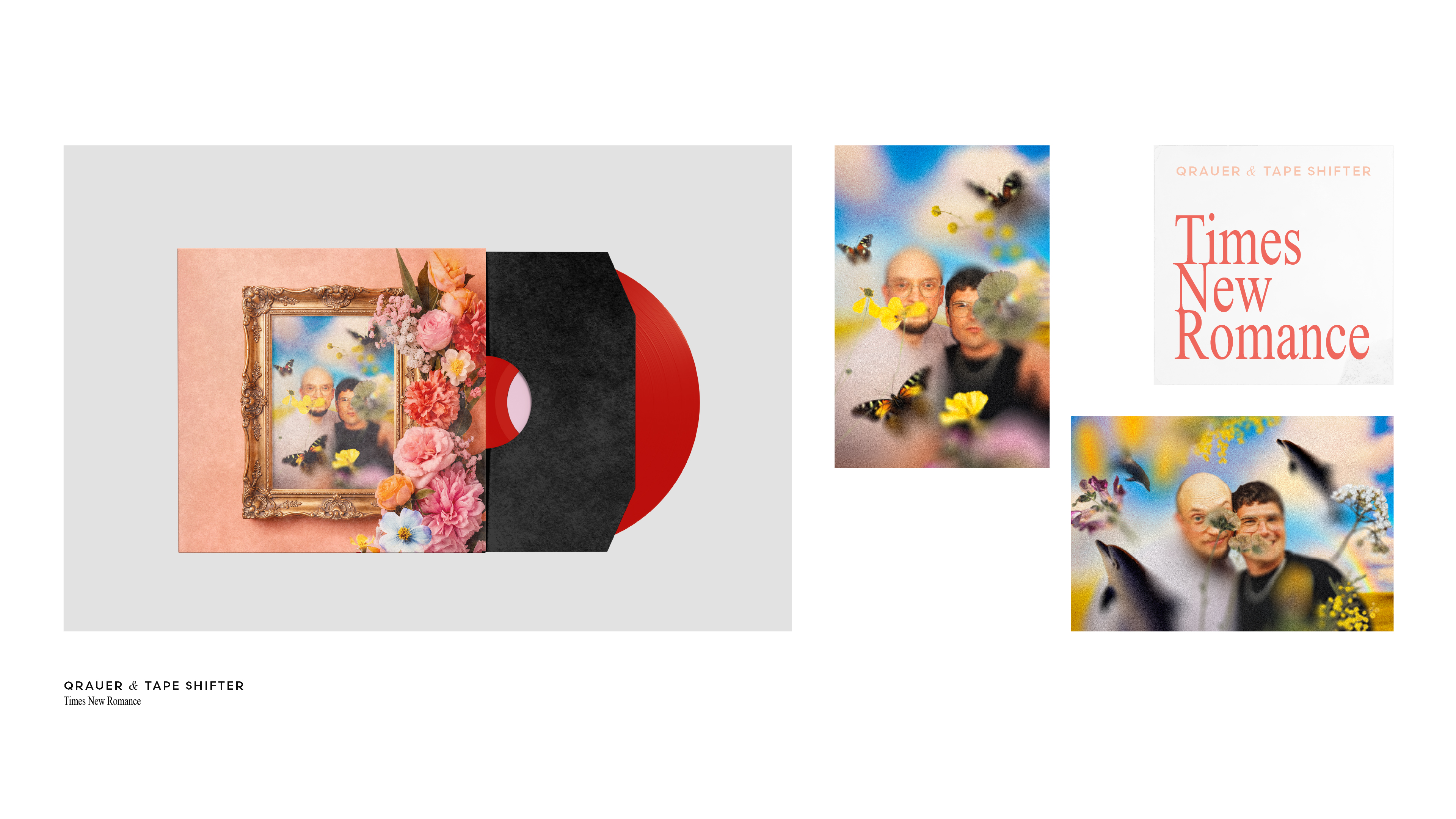
7. The title Times New Romance sounds like a wink at a very familiar typeface. Was that the starting point, or did the title arrive after the music?
The name “Times New Romance” had been floating around in Christian’s head for a few years after he misread a piece of graffiti that simply read the font name in the font’s own style. As he is a designer as well as a musician, it became a great desire of his to use this romantic twist as the title for a release at some point. After our first EP had been given the wonderful title “Herzblatt”, it was time for Times New Romance. And what better time than now to spread a little love and warmth.
8. The record is described as exploring romance and intimacy in times of uncertainty, with a playful, surreal touch. How do you see those two things, uncertainty and playfulness, living together in the same music?
This is particularly evident in the way our music is essentially created through improvisation. Not just in the rehearsal room, but also when we’re playing live. It is precisely there that this blend of playfulness and uncertainty produces the results that we ultimately find so exciting.
9. Your track titles move between English and German: “Blaue Decke,” “Warteschleife,” “Cudo,” “Fun Fact.” Is there a story behind those choices, and do you think of the titles as part of the music?
It is usually spontaneous ideas that spring to Christian’s mind whilst he is producing the tracks. Sometimes they are triggered by elements in the music, and sometimes they simply seem to float in from the cosmos for no apparent reason. As a result, they become an extension of the musical interplay between qrauer and Tape Shifter.
10. Live experimental electronics, irregular rhythms and heavy bass sit side by side here. What does your setup look like when you are building a track, and how much of what we hear was played live rather than programmed?
Our drumming history makes a certain kind of beat the very base of a tune. Also the little happy accidents. They are all over the place since we are programming the drum computers in real time while all kinds of live sampled tape snippets fly by. These can be noisy but also percussive or bassy. Whenever something new adds to the beat in the improv we start counterpointing with the 808, the Model Samples (both drum machines) and our transparentSea effect section, which is produced by Christian and his friend Richard at their company ginTronic.
11. The credits mention a tape master and a vinyl cut. How much does the physical life of the music, the tape and the groove, shape the way you make and finish it?
All different materials (besides the digitality) in the work tell a story full of listener’s experiences, music history and contrasts within all decades and genres. That can be tape with its saturation giving us a sense of our own first steps in music as kids and vinyl being the medium of our parents. We love the ceremony that comes with it when you put on a record.
Also using old tapes: you can very much hear time and transience in them as well as levels of re-recording comparable to a tree’s bark. Digital often comes with a certain synchronicity and a cleanliness more equivalent to machines. Life is more wobbly, unstable and surprising though!
12. The five tracks are compact, each running around three minutes. Was that a decision from the start, or did the material simply ask for it?
The length of the tracks is more or less a matter of chance, with no specific purpose in mind. When selecting material from recordings of rehearsals and performances, it is often specific shorter passages lasting just a few minutes that subsequently become standalone pieces. Their length is largely retained and does not change significantly.
Thanks to qrauer and Tape Shifter for their time and for the music. Times New Romance is out now on Sonderling Records, and you can support the release and buy it on Bandcamp: https://qrauertapeshifter.bandcamp.com/album/times-new-romance. We are curious to see where this unlikely pairing goes next, and we’ll be listening.
Artist: qrauer & TAPE SHIFTER
Title: Times New Romance
Label: Sonderling Records
Release Date: November 6, 2026
Support & Buy: Bandcamp
Tracklist
1. Cudo (feat. Paul Frick) 02:52
2. Times New Romance 03:31
3. Blaue Decke 03:21
4. Fun Fact (feat. Moritz Fasbender) 03:03
5. Warteschleife 03:34
Credits
Written by Demian Kappenstein & Christian Grochau
Except «Cudo» written by Demian Kappenstein, Christian Grochau & Paul Frick, Except «Fun Fact» written by Demian Kappenstein, Christian Grochau & Friederike Bernhardt
Produced and mixed by Christian Grochau
Tape Master by Jacob Korn (tailout.de)
Vinyl Cut by Niklas Worgt (ilovevinyl.de)
Artwork by Jonny Polka (jonnypolka.com)
Besonderling Rec./Sonderling Records
Beso05
qrauer
Website | SoundCloud | Instagram | Threads | Bandcamp
Tape Shifter
Sonderling Records
Website | SoundCloud | Instagram | Bandcamp | Linktree
Club Furies
Website | SoundCloud | Instagram | Threads | TikTok | Facebook | Bandcamp | Linktree


Deja una respuesta